Anyone who’s watched a live stream stutter, buffer, or drop quality in real time knows the frustration. Switch networks, WiFi to 5G, or 5G back to 3G, and the problem gets worse. For applications where timing and reliability actually matter, like webinars with live Q&A, sports betting, or live auctions, those interruptions don’t just annoy users. They cost you.
The live streaming workflow and where it breaks
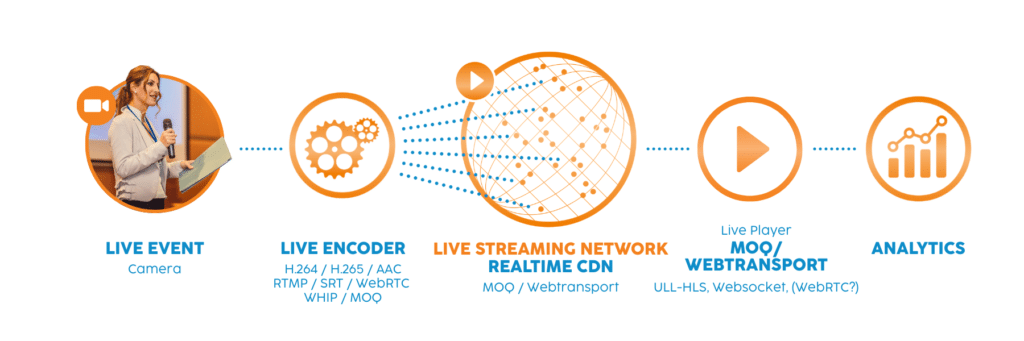
A typical live stream travels across three segments. A camera feeds into an encoder, which sends the stream to a live platform and CDN. That’s the first mile. The CDN handles global distribution across regions, the middle mile. Viewers pull the stream from the nearest server via a player in their browser, the last mile.
Each segment affects quality and latency. MOQ addresses all three.
Compared to HLS, RTMP, and WebRTC, MOQ is the only protocol that combines sub-second latency with broadcast-scale audience reach.
How MOQ changes things
Media Over QUIC (MOQ) is reshaping live media delivery by replacing the TCP-based protocols most streaming infrastructure still depends on. Built on WebTransport, HTTP/3, and QUIC, it’s designed for faster recovery, lower latency, and more resilient performance, even when network conditions aren’t ideal.
This article, updated April 2026, explains how MOQ works, where it fits in the live streaming workflow, and how nanocosmos applies it inside its real-time video platform.
Table of contents
- What is Media Over QUIC (MOQ)?
- Which parts of the workflow are covered for MOQ?
- Why Is MOQ Important?
- MOQ in Production: One Year of Real Data
- Use Cases for MOQ Streaming
- How Does MOQ Work?
- How to Implement MOQ for Real-Time Live Streaming
- The Future of MOQ and Real-Time Streaming
- nanocosmos and MOQ: Shaping the Future of Real-Time Streaming
What is Media Over QUIC (MOQ)?
MOQ (Media Over QUIC) is a next-generation transport protocol built specifically for real-time media streaming. Based on QUIC, MOQ takes live streaming to the next level.
Designed with the needs of live streaming in mind, MOQ offers:
- Ultra-low latency – low connection times and stream delay for real-time interaction.
- Seamless streaming with smoother experiences, even on unstable or fluctuating networks (fewer interruptions and buffering).
- Adaptive Bitrate and Stream prioritization: streams always get the bandwidth they need.
- Scalability, perfect for one-on-many applications of any audience size.
MOQ ensures live media streams are reliable and high-quality—even in less-than-ideal network conditions- by leveraging the built-in strengths of QUIC compared to TCP:
- Faster connection times
- Resilience to packet loss
- Smarter congestion control
- Less buffering, higher speed, lower latency
Whether used over raw QUIC or WebTransport, MOQ adds flexibility and precision, making it an ideal solution for broadcasters and developers looking to deliver smooth, reliable streaming experiences.
Which parts of the workflow are covered for MOQ?
MOQ plays its major role in the last mile, delivery to the clients, but also in the middle mile in the CDN to deliver streams efficiently around the globe, between origin and edge relay servers.
What about MOQ ingest?
MOQ ingest is new, but it will come! There is initial support for MOQ for OBS (developed based on the MONTEvideo summer camp), which nanocosmos was part of. Hardware vendors are considering adding MOQ as an ingest protocol as well.
Why Is MOQ Important?
Global audiences expect live streaming platforms to work seamlessly on any device and network, whether at home, on the move, or across varying connections. Platforms have to deliver exceptional video quality and reliable performance 24/7, with ultra-low latency for real-time interaction—critical for monetized applications like gaming and betting, where engagement drives revenue.
Solutions like nanocosmos’ H5Live Delivery and Playback enable global real-time streaming with ultra-low latency and scalability, even under challenging conditions, based on existing web technologies. While other technologies like WebRTC work well for peer-to-peer video, they struggle to scale for broader live streaming. With QUIC and Webtransport now widely available in browsers, the streaming landscape is evolving. MOQ enhances this further, enabling smoother, ultra-low-latency performance on unstable networks.
However, the streaming technology itself is not the only thing to look at. It needs to be deployed and made available in an easy-to-use way. For interactive use cases like iGaming, auctions, or town halls, achieving real-time engagement at scale requires an end-to-end optimized workflow. MOQ builds on innovations from vendors like nanocosmos, offering a robust, scalable solution that unifies media delivery, overcoming current limitations and enabling real-time communication with both speed and scale.
MOQ in Production: One Year of Real Data
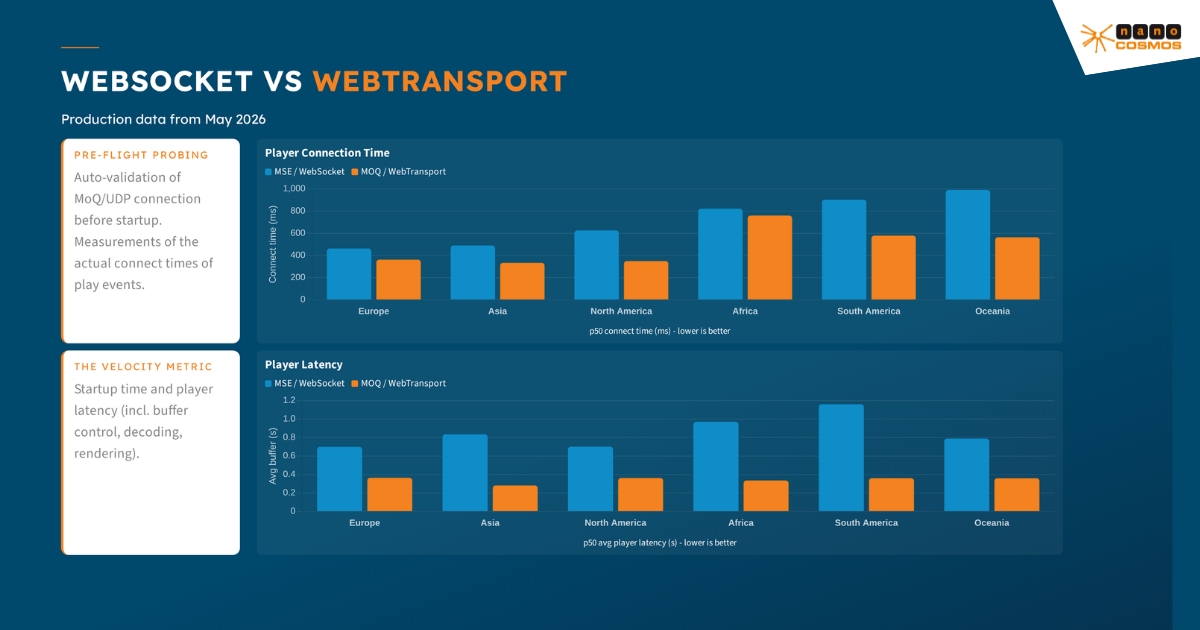
After a year of MOQ running in production, we have something more useful than benchmarks: actual numbers from real streams, across real networks.
The comparison is MSE/WebSocket versus MOQ/WebTransport. Two metrics: player connection time and player latency. Data collected across Europe, Asia, North America, South America, Africa, and Oceania.
Connection time is lower with MOQ/WebTransport in every region. On player latency, MOQ reduces average buffer time by at least 200ms compared to MSE/WebSocket — consistently, not as an outlier.
For ultra-low latency use cases, 200ms is a meaningful difference. That is roughly the threshold where latency becomes perceptible to viewers.
Use Cases for MOQ Streaming
MOQ can be used in different industries and applications to enhance the user experience for live streaming:
- Live Events and Virtual Town Halls: reduced latency and better scale
- Webinars and E-Learning: improved access from any location for real-time Q&A.
- Online Gambling, iGaming, Sports betting: real-time interactivity is crucial for horse racing, online casinos, and poker platforms.
- Live Commerce and Auctions: enhanced live shopping experiences for real-time interaction, enhancing the feeling of urgency and excitement.
- Real-Time Collaboration: MOQ benefits applications like video conferencing, online meetings, and webinars by enabling smooth, low-latency interactions.
How Does MOQ Work?
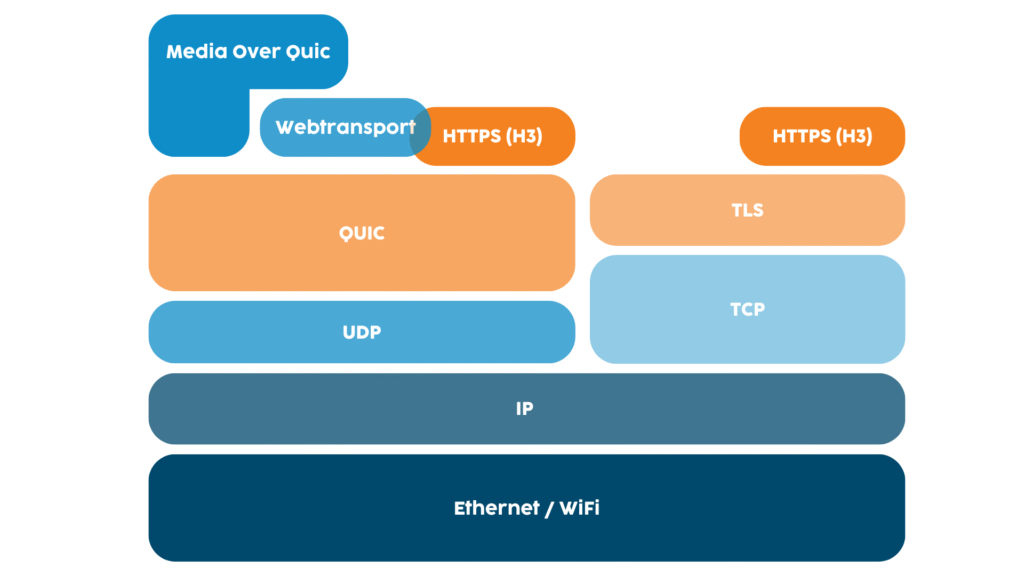
MOQ is a media transport protocol designed to operate over QUIC and WebTransport, offering seamless, real-time communication for live streaming and interactive applications. QUIC, part of the HTTP/3 standard, uses the UDP protocol at the network layer, providing significant advantages over traditional TCP-based HTTP connections.
Both MOQ and QUIC introduce innovations that overcome limitations in HTTP over TCP, particularly for latency-sensitive, real-time applications such as live streaming, gaming, and video conferencing.
WebTransport: A Key Building Block
WebTransport is a web framework designed for web browsers that enables efficient client-server communication over QUIC. It allows for real-time data transmission, offering a simplified model similar to the existing Websocket protocol, and compared to the more complex protocol WebRTC, which was designed for peer-to-peer communication with a lot of complexity under the hood.
WebTransport is ideal for applications like live streaming, where client-server interactions are predominant.
WebTransport and MOQ combine to deliver ultra-low latency, making it perfect for interactive streaming experiences like live events, gaming, and video conferencing.
With MOQ, live streaming achieves near-instantaneous playback, even during network interruptions.
The Role of HTTP/3
HTTP/3, built on top of QUIC, replaces the older TCP-based transport layer used with HTTP/1 and HTTP/2, solving issues like connection establishment delays and head-of-line blocking. For live streaming, HTTP/3 offers:
- Faster content delivery and network connection
- Better packet loss handling
- Improved performance on mobile networks
Tech Comparison: QUIC vs. TCP
QUIC means “Quick UDP Internet Connection” and is based on UDP with additional benefits: Error correction, packet loss handling, encryption and more. The lowest software level of network connection protocols is TCP and UDP, which have existed for decades but create challenges for modern media transport in diverse network situations. QUIC combines the benefits of a new, unique transport protocol.
| Feature | TCP | QUIC |
| Connection Establishment | Multi-step handshake (SYN, SYN-ACK, ACK) | Quick single-step handshake combining connection and cryptographic setup, allows stable connections in “roaming” situations |
| Latency | Higher latency due to strict ordering of packets and packet confirmations (ACK), can lead to congestion | Reduced latency by allowing independent streams without head-of-line blocking (congestion) |
| Packet Loss Handling | Retransmits all data, blocking subsequent packets | Retransmits only lost packets, unaffected streams continue |
| Encryption | Optional encryption via TLS | QUIC connections are all encrypted |
| Multiplexing | Supported by HTTP/2, but shares the same TCP connection, vulnerable to blocking | Built-in multiplexing at the protocol level, avoiding head-of-line blocking |
This diagram shows how “quick” a QUIC connection is established compared to a TCP connection:
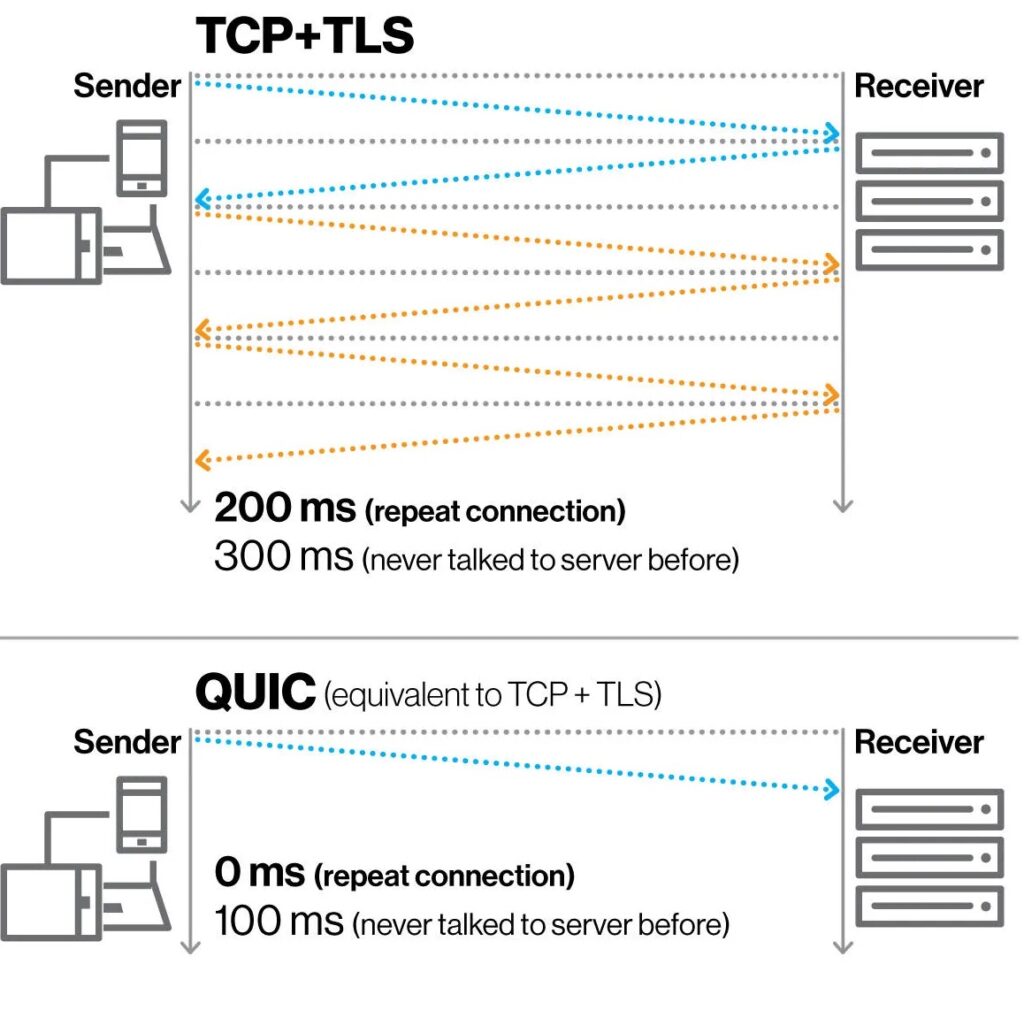
(Image Source: Edgecast )
Tech Comparison: MOQ vs. HLS and DASH
MOQ and HLS, and DASH are designed to handle media streaming. However, HLS and DASH have fundamental issues for real-time video: they are based on “chunked” video segments, which always create significant latency. In practice, HLS segments are at least 2 seconds long and grouped together as 3 segments, which leads to latency values of 6 seconds or more. In reality, this goes up to 30 seconds or more, which makes it impossible to use for real-time interaction.
Tech Comparison: MOQ vs. WebRTC
MOQ and WebRTC are both designed to handle real-time communication and media streaming. However, they cater to different use cases and architectural preferences, with distinct design philosophies and trade-offs.
MOQ is based on a simple, modular architecture based on WebTransport and QUIC. It is designed to work in broadcast-grade and high-quality video streaming environments, including Adaptive Bitrate Playback. WebRTC is a monolithic architecture designed for peer-to-peer video telephony, with a lot of complexity under the hood but less flexibility for video stream configuration and buffer control. Additional requirements for STUN and TURN servers make deployments challenging. MOQ can even reduce latency compared to WebRTC!
nanocosmos leverages both WebRTC and MOQ depending on the use case. While WebRTC is preferred for browser-based ingest in web applications, MOQ is the go-to choice for stable, large-scale delivery to a global audience, including Adaptive Bitrate Playback to adjust to downstream network bandwidth automatically. This ensures high-quality, reliable streaming at scale, tailored to the specific needs of each application.
Media over QUIC Vs. WebRTC
| Aspect | MOQ (Media over QUIC) | WebRTC |
| Video Quality | Supports high-quality video/audio configurations for broadcast-grade applications (no codec or profile dependencies) | Typically lower video quality, optimized for real-time communication / video meetings (usually limited codec config, no B-Frames) |
| Target Use Case | One-to-many, any scale, real-time media delivery (e.g., live streaming, video broadcasting) | Peer-to-peer video telephony or conferencing, small interactive sessions, not designed for live streaming |
| Transport Layer | Built on QUIC, supporting multiplexing, encryption, and low latency | Uses RTP/UDP for media and SCTP/DTLS for data channels |
| Network Handling | Resilient to poor network conditions, with features like adaptive bitrate playback | Can struggle with bitrate adaptation and frame drops in bad network situations |
| Architecture | Modular and scalable, supporting CDN and flexible codec configurations. | Monolithic and complex, requiring additional components (e.g., SFU, TURN servers) , complex Firewall rules |
| Use Cases | Best for live streaming, gaming, betting, and town halls | Best for peer-to-peer video calls and small-group interactive sessions |
Introducing the MoQT Standard
The MOQT (Media Over QUIC Transport) standard combines the best features of MOQ, WebTransport, and HTTP/3 into a unified standard framework designed to modernize and enhance live streaming protocols. As an ongoing IETF initiative, MOQT is continually evolving to meet the growing demands of real-time media delivery, ensuring it remains at the cutting edge of streaming technology. MOQT is still under development based on different “draft standards”, such as draft 14, 15, 16, which are all incompatible with each other. Vendors like nanocosmos picked elements of the drafts to create their own version of MOQ to accelerate production rollout in stable live environments for over one year.
Which browsers support MOQ?
As of March 2026, Media Over QUIC support depends on WebTransport and WebCodecs APIs available in industry-standard web browsers.
And since then, it has been supported on all major browsers, which offers a complete MOQ-based solution!
- Google Chrome, Microsoft Edge & Other Chromium-Based Browsers (like Opera): Full support for WebTransport and WebCodecs, making it the most compatible option.
- Mozilla Firefox: Full support for MOQ and Webtransport
- Apple Safari: Now fully supports MOQ based on WebTransport and WebCodecs since iOS 26.4!
How to Implement MOQ for Real-Time Live Streaming
While MOQ excels at real-time video and audio transport, a complete live-streaming platform requires more:
- End-to-End Architecture: Smooth communication and ultra-low latency from ingest to playback across devices.
- 24/7 Uptime: Robust monitoring and dedicated support ensure constant availability and error-free operation.
- Global Scalability (CDN): A worldwide CDN with origin/edge architecture delivers fast, reliable streams, handling high traffic with low latency.
- Real-Time Analytics: Instant insights on performance enable real-time monitoring, quick issue resolution, and stream optimization.
- Advanced Security: End-to-end encryption and content protection prevent piracy and unauthorized access.
- Professional Support: Continuous oversight and rapid technical support ensure consistent performance and scalability.
These components together enable seamless, high-quality, globally scalable real-time streaming. Read more about the hidden costs of building a real-time streaming platform.
The Future of MOQ and Real-Time Streaming
As demand for high-quality live streaming grows, technologies like MOQ, WebTransport, HTTP/3, and MOQT are redefining real-time streaming. These innovations enable faster, more reliable, and scalable experiences, helping developers and broadcasters meet global audience needs.
By adopting these technologies, the streaming industry unlocks new levels of interactivity, engagement, and performance across entertainment, enterprise, and beyond. The future of live streaming is here, for speed, scale, and seamless interaction.
Are you ready to be part of it?
nanocosmos and MOQ: Shaping the Future of Real-Time Streaming
nanocosmos was the first vendor to bring Media over QUIC into production in 2025, with its official launch on the nanocosmos platform during the IBC 2025. It proves how nanocosmos remains at the forefront of innovation with a strong customer-focused approach, driving the future of real-time streaming.
With the nanocosmos platform, our real-time streaming platform, we leverage MOQ to deliver exceptional experiences with:
- Sub-Second Latency: Ideal for interactive use cases like live events, gaming, and betting.
- Global CDN: Ensures 100% uptime, 24/7 operation, and scalable delivery to audiences worldwide.
- Dynamic Real-Time Player: Seamless integration for smooth, low-latency playback on any device or location.
- Advanced Analytics: In-depth insights for monitoring, optimizing, and troubleshooting stream performance in real time.
The nanocosmos platform uniquely integrates both established and emerging ultra-low-latency technologies, delivering a consistent, high-quality user experience across platforms, devices, and browsers. By harnessing the latest advancements, it ensures optimal performance and reliability, regardless of the user’s environment.
Interested in taking the next steps? Just sign up for the nanocosmos Platform – it’s free for developers, and has great commercial options to get started with MOQ!
Learn more about video technology and listen to this podcast with industry experts, “Voices of Video – Breaking Barriers in Low Latency Communication“.
Got questions? Reach out to our team.