
Live casinos have become one of the most important growth drivers in today’s iGaming industry, where revenue is expected to have a projected market volume of US$717.06bn by 2030, according to Statista’s recent study.
By combining real dealers, physical tables, and real-time video streaming with ultra-low latency, live casinos deliver an experience that bridges the gap between land-based gaming and online play, transforming it into a global, engaging and interactive experience.
Launching a live casino in 2026, however, is no longer just about putting cameras in a studio and going live. Player expectations, reliable live streaming technology with high video quality, and global scalability requirements have evolved significantly. Today’s successful live casino operations depend on a carefully planned, technology-driven setup — from professional studio production to ultra-low-latency streaming and reliable global delivery workflows.
After talking to industry experts, we will focus this article on the technical and operational setup of a live casino. We assume that licensing and regulatory requirements are already in place, so we will not cover compliance topics.
We’ll walk through a strategic checklist for launching a competitive live casino. We’ll cover studio design and setup, video streaming technology, scalability, interactivity, analytics, and the innovations shaping iGaming.
Table of contents
Why 2026 Is a Critical Year for Live Casino Growth
The live casino market continues to mature rapidly. What started as a differentiator has now become a baseline expectation for many iGaming platforms. In 2026, competition is no longer just about offering live games, but also about how well they are delivered and the user experience.
Players now expect real-time interaction, mobile-first performance, and robust 24/7 availability across global regions and devices. Any delay, stream instability, or poor video quality directly impacts trust, fairness and revenue. As a result, operators entering or expanding in the live casino market should follow a structured, end-to-end approach. This should prioritize performance, scalability, and player experience from day one.
Operators who invest early in modern, scalable live casino streaming infrastructure are better positioned to expand into new markets, support higher player volumes, and introduce innovative formats without having to rebuild their technology stack.
Define Your Live Casino Model
Before any technical setup begins, operators need clarity on their live casino model. Once the business model is clearly defined, it becomes significantly easier to make the right decisions around studio design, streaming technology, and scalability.
We assume that the common ground of live casino is that there is a real person (a dealer) at a gaming table or device who is presenting and running the game. This can be any type of game, like roulette, blackjack, live patti, baccarat, bingo, and others.
Key considerations you need to make include:
- In-house live casino studio or third-party production? You don’t need to build everything from scratch for your live casino or create a TV show setup. Have in mind that players want to play for a long time straight, even for hours, in a simple way. If you decide on a third-party solution, companies like Amber Studios has different options of live studio setup for you, while 1b.live offers live dealer tables at an affordable cost.
- Which markets and regions will you target? Most live casinos want to go live globally. However, having your content tailored to the right audience is always important. For instance, the right language or at least with translation captions, the outfit that fits the culture, and music. Every culture has its own nuances when it comes to live dealer games.
- Types of games and tables offered: Sic Bo, roulette, blackjack, baccarat, bingo, and more. It’s important to define exactly which games you plan to stream, as each has different technical and production requirements. For example, some live games require a two-camera setup with different angles to ensure clear visibility. In a bingo live stream, one camera may focus on the drawer while another captures the ball to provide transparency and maintain playertrust.
- Level of branding and customization: From simple on-screen graphics, such as logos and brand colors in the video player, to fully branded studios with custom tables, dealer uniforms, and themed environments. You may start simple and evolve within the time, adding customization as the business becomes more solid, to a multi-tier studio environment with professional video production based on green screen keying or other advanced production techniques.
Studio and Production Setup for streaming games
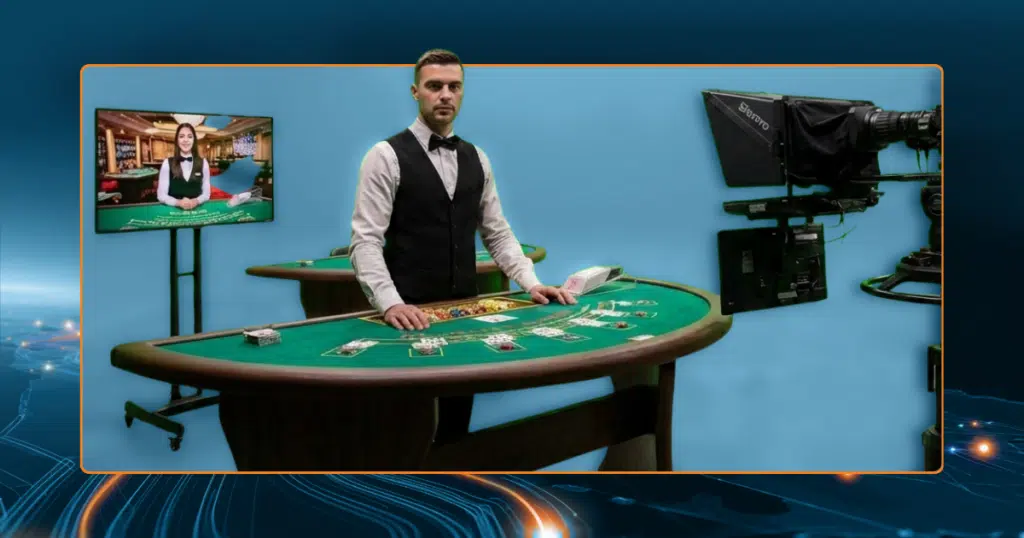
A professional studio setup is the foundation of any live casino operation. The goal is to create a controlled, broadcast-grade environment that can operate reliably around the clock.
Audio/Video Production: Lights, Cameras, Microphones
Cameras, lighting, and audio are the first technical elements to set up when starting a live casino for a better user experience and long-term player engagement.
Even though a good quality of these three aspects is essential, keeping your studio simple will work better than having a great TV show-style setup. You don’t want your players to get distracted or tired after some minutes of live-streaming your games. You want to ensure that the audio quality is high enough for the global audience to listen to the dealer.
The right Lighting and Audio:
Lighting and audio are two essential aspects to set up right for a live casino. Players need to see what is happening on the table during the live streaming and to hear the dealer clearly to avoid distractions and lose trust.
When it comes to lighting, working in dark environments is something to avoid. Land-based casinos are normally dark, but cameras don’t like darkness. Consider a well-lit environment in your studio and even improve the quality in post-production to avoid shadows and glares on tables
Bad light compromises the image and user experience, as it can drastically change the image. Everything needs to be seen. Make sure the image is clear, and players are able to see what they need to see.
A common mistake in live casino studios is using overhead lighting that creates glare on the table’s surface or harsh shadows on the dealer’s hands. This can make cards and chips harder to see and negatively affect player trust. To avoid this, studios should use diffused, evenly distributed lighting positioned at controlled angles, combined with matte table surfaces.
On the audio side, relying on room microphones often results in echo and unwanted background noise. The right choice of microphones depends on the specific application and studio layout. Depending on the scenario, studios may use shotgun microphones, table microphones, or lavalier microphones, either wired or wireless. Each option has trade-offs in terms of sound isolation, flexibility, and reliability.
The key is selecting a microphone configuration that delivers clear, consistent audio while minimizing background noise and operational complexity for the specific live casino environment.
Even in live streams, audio quality can be further enhanced through real-time processing, such as noise reduction, equalization, and compression, ensuring a clean and professional sound experience for players.
Live Encoders for live casino real-time video:
For connecting a live camera to the internet, you need a live video encoder. This is usually a hardware device, but can also be a laptop or PC with a software running on it, like the free OBS, which is also used in general live video streaming use cases like Twitch or YouTube Live.
If you’re unsure which cameras, encoders, and production to use for your live casino, you can explore here the nanoStream partners, who are certified to work seamlessly with the nanoStream platform. We advise you to have a local video production company or an experienced person on the ground to help you set up the production environment.
High-quality cameras paired with low-latency live video encoders ensure sharp video and smooth motion, and high video quality. On this topic, the encoder configuration is critical, as inefficient encoding directly increases latency and bandwidth usage.
Be aware that for any internet connection, the video will be compressed and lose a bit of quality (ideally with no visible impact). You can decide on the basic quality in the encoder configuration (Video resolution and bitrate).
In iGaming, keep in mind that the viewing experience is predominantly mobile-first from smartphones and tablets, where screen sizes and network conditions make ultra-high resolutions unnecessary. For this reason, ultra-high resolutions will not be necessary. We rarely see video resolutions beyond Full HD (1920×1080), and rarely 4K. Streaming in 4K provides little to no perceptible benefit on small screens, while significantly increasing bitrate requirements, latency, and infrastructure costs.
Optimizing video quality resolutions such as Full HD or 720 HD—combined with efficient encoding profiles—delivers the best balance between visual quality, performance, and scalability for mobile audiences.
Besides that, for the video bitrates, you might want to stay in the medium range, which creates acceptable quality. If the quality is too high, it would raise your internet bandwidth cost.
Recommended Encoder setup for real-time video:
- The video encode format when using the nanoStream platform is H264, and the audio encode format is AAC.
- Recommended video encode profile is the base profile.
- Recommended maximum 4Mbps for HD 1080p video.
- The recommended video rate is 25 fps or 30 fps.
- Important for the keyframe interval to be two seconds.
- Video bitrates not higher than 6 Mbits/s for Full HD or 3 Mbits/s for HD 720.
Backup Power and Network Redundancy:
Live casinos operate 24/7. Redundant power supplies and network connections are essential to prevent downtime and protect revenue.
How to make sure your Internet Service Provider (ISP) is good for your live streams:
- Ensure the internet network bandwidth is at least 2.5 times the total of all bandwidths of all streams using the same connection.
- Recommended to have two different ISPs for failover switching whenever one ISP is having a degrading connection.
- Please note that even for nominal good connections like 50 Mbits/s upstream from your ISP, it may not be as good in the real environment. It may go down in the average bandwidth and may have dropouts for 24/7 operation.
Example calculation: 5 Tables with Full HD Live Streams each 6 Mbits/s = 30 Mbits/s => We recommend a guaranteed upstream bandwidth by your provider of 75 Mbits/s
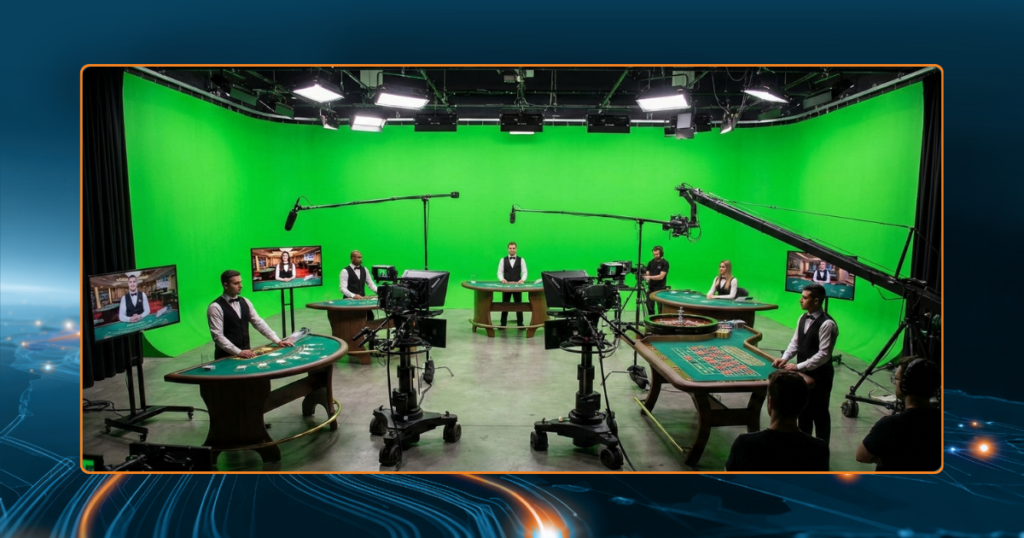
Table Setup:
Table design should support camera angles, chip visibility, and integration with game logic systems for accurate real-time bets.
A frequent setup mistake is using standard casino tables that block key camera angles or obscure chips and cards when viewed from above. This can lead to unclear gameplay and player confusion.
Test environment for global live casinos:
More than having your studio ready, testing your setup first is very important to have a smooth live stream. Set up everything as if you’re going to go live,e but start streaming locally, for instance, at your office. Then, from another locationand maybe using a VPN to simulate a stream to other countries. Ask your team to test everything to avoid mistakes when streaming for real.
Last but not least, having a team with good professionals is important. However, make sure that at least one person on your team knows about live casinos and players to test all you created as if they were playing themselves.
Dealer Training:
Starting a live casino goes beyond the technical part; the operational part is also crucial. Spend time training people who will go in front of the camera during your live streaming. The quality of presentation is more key, especially when starting.
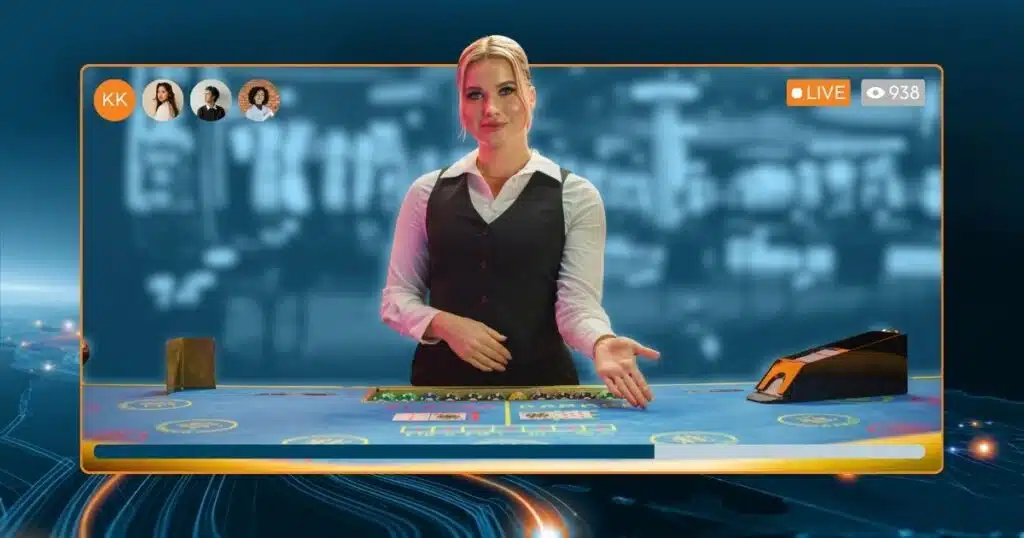
Training people who go in front of the camera is very important as well. Dealers are not just game facilitators, but also on-camera hosts. Training should focus on presentation, pacing, and interaction with players via chat or on-screen prompts.
Choosing the Right Live Streaming Technology
Streaming technology is the most critical decision in a live casino setup. Every player interaction depends on it. Choosing an end-to-end approach will simplify your entire workflow and is crucial to achieving ultra-low latency. Choose partners wisely and trust them. Partners as nanocosmos, with over 10 years of experience in the industry, want you to succeed in your business and will help you achieve your goals.
Taking care of streaming is a great extra work. If you decide to do this on your own, you risk being taken away from your main business: your games.
Key requirements when considering a real-time video platform:
- Sub-second latency to enable real-time bets and interactions.
- 24/7 operations and 100% uptime.
- Scalability to handle peak traffic, growth, and new game formats.
- Global delivery with consistent performance across regions.
- Stream analytics, alerting, and operational visibility.
- Advanced security to protect streams and prevent misuse.
- Dedicated support for quick communication, issue resolution, and improvements.
- Maintenance and updates, as technology is changing all the time.
Scalability, in particular, goes beyond simply supporting more viewers. A live casino must deliver the same level of latency, quality, and stability across different regions, devices, and network conditions. As platforms expand, operators need to support multiple markets simultaneously, handle varying bandwidth qualities, and absorb traffic spikes without compromising the experience.
End-to-End approach for live casino real-time video:
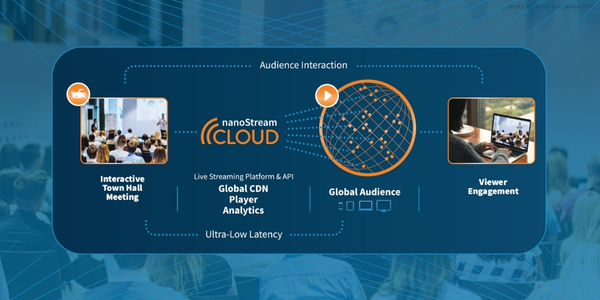
This is where specialized live streaming platforms make a difference. nanoStream is an end-to-end streaming solution purpose-built for real-time, interactive applications like live casinos. The comprehensive platform enables operators to deliver stable, low-latency real-time video experiences. Everything without building and maintaining a complex streaming infrastructure themselves.
The nanoStream platform combines a global Content Delivery Network (CDN), video player, and analytics into a single solution. This gives you full control over your live streams with proven reliability worldwide—regardless of location, device, or the type of internet connection.
Some of the key capabilities nanoStream offers to iGaming providers include:
- Adaptive Streaming
The nanoStream platform offers adaptive bitrate. It will automatically detect any connection problems and prioritize your live stream. This way, everything keeps running even in challenging network environments. Whether players are in remote regions or on the move—such as riding on a bus—the stream adapts to their internet conditions and continues playing smoothly, keeping engagement high.
Since 2025, the nanoStream platform has been powered by the latest streaming technology, Media over QUIC (MOQ), ensuring even more network resilience.
- Analytics and Security
In addition to ultra-low latency delivery, nanoStream provides advanced analytics for full visibility and control over the live streams. Monitoring and performance insights provide valuable data that help improve operations and reduce support time. At the same time, robust security and advanced protection mechanisms safeguard your streams against misuse, content hijacking, and service disruptions.
- Additional Features: Live Video Processing and Recording
Beyond core streaming, the platform includes powerful features designed specifically for iGaming workflows. For instance, live replay and clip sharing for attracting more players, live translation, automated thumbnail generation, and other tools that simplify operations, enhance player engagement, and extend the reach of live casino content across channels.
In summary, working closely with a live streaming solution partner and communicating goals transparently enables tailored solutions that grow alongside the business. This approach allows operators to focus on game innovation and player engagement, while the underlying streaming technology runs smoothly in the background. Test nanoStream 30 days for free and see for yourself the real-time video that simply works.
Continuous Optimization and 2026 Trends
Live casinos are not static products. For this reason, continuous optimization is essential to staying competitive.
Start simple, and improve and optimize while running your live casino with knowledge of your audience, business goals and the right technology behind.
Key trends shaping 2026 include:
- AI-assisted dealers and studio automation.
- Personalized live experiences based on player behavior.
- New use cases like “Bet behind” with real-time bets.
- Further ultra-low-latency innovation with new technologies such as MOQ, already in production on nanoStream, providing robust video quality and latency.
- Advanced video production and processing in the cloud.
Operators who choose flexible, future-ready streaming platforms can adopt these innovations without reworking their entire infrastructure.