When distributing live video online, there’s a lot to consider. Ensuring a high-quality experience for viewers across the globe is no easy feat. What’s more, many content distributors struggle to minimize the delay between content capture and playback on end-user devices. Called video latency, this is a critical factor for interactive live streaming use cases.
In this article, we detail what video latency is possible in 2026, tips for reducing streaming lag, and explore strategies for businesses to achieve real-time streaming with a focus on maintaining a superior quality of service and audience experience. To give you a bit of context, this article is about the workflow and use case of live streaming from one source to many participants, for any audience size, anywhere in the world.
Table of contents
What Is Video Latency?
Video latency is the lag between capturing a video in loco and displaying the video on a viewer’s screen. Although there’s no streaming industry standard for latency terminology, at nanocosmos, we break it up into four categories:
- High latency: In many streaming workflows, the latency is somewhere north of 30 seconds. This is because standard HTTP-based protocols like HLS default to 6-second segment lengths, and three segments are required before a video will play back. This delay is only acceptable for linear programming, and even then, it’s not ideal.
- Typical latency: It sits between 6 and 30 seconds. Many live news and sports broadcasters are comfortable with this delay. But as second-screen experiences, watch parties, and interactive overlays become more common, the industry is looking to close this gap.
- Low latency: When a stream is tuned for low latency, it reaches viewers 1 to 6 seconds after the video is captured. Many social media sites fall in this range, which is why there’s often a disconnect between when a comment shows up on the screen and when it’s acknowledged by the person streaming.
- Ultra-low latency or real-time: Sub-second streaming falls in the category, and it’s ideal for real-time entertainment. Interactive content like gaming, virtual events, and more should always aim for this target. You’ll see us use ‘real-time,’ ‘ultra-low latency,’ and ‘sub-second’ to refer to the same thing throughout this article.
You may be surprised to read about “long” and “typical” latency of several seconds! This is caused by the nature of video streaming. With the invention of the HLS protocols by Apple, streaming became simpler than before, but this protocol induced significant latency into the video stream. This did not matter back then, when live streaming was less prominent and more used for TV-like “broadcast” applications.
When Does Low Latency Matter?
So why is video latency problematic, anyway? The most popular example is that of hearing your neighbour celebrate a goal while the live sports broadcast that you’re watching lags behind. But there are many more dire reasons to reduce latency.
For video experiences that require two-way participation, the effects of video latency can be disastrous. Imagine attempting to place a bid during a live auction, only to find out 30 seconds later that someone else bought the item for a much lower price than you were willing to offer. In this case, the delay would result in a terrible experience for viewers and lost revenue for the auction house.
As mentioned, not all live streaming applications need low latency. In broadcast applications like OTT (Over-The-Top) without interaction, latency isn’t a critical factor. The primary concern might be synchronizing “audience cheers” with other broadcast channels such as cable TV or radio, placing it in the “medium-low” latency range of approximately 6-10 seconds.
Who Needs Low-Latency Streaming?
Almost any interactive real-time streaming use case where viewers are able to influence the content through participation requires real-time streaming. Minimizing the delay is key to maximizing engagement.
Here’s a closer look at some of the video-based experiences where ultra-low latency is a must:
- Online gambling and igaming. In today’s online gambling environments, players make split-second decisions while watching live events. Online casinos, sportsbooks, and other igaming platforms need ultra-low latency streaming to ensure placing their participants’ bets on time. And with new use cases like microbetting gaining momentum, the requirement for speedy video delivery continues to grow.
- Live commerce and real-time auctions. When it comes to live shopping, timing is everything. The urgency that real-time streaming delivers motivates buyers. What’s more, the ability to chat during a makeup demo, place a bid during an auction, or purchase the last remaining item requires sub-second latency.
- Townhalls, Corporate Events and Webinars: These cases increasingly use ultra-low latency streaming to foster engagement and interaction across global teams. Sub-second streaming transforms passive video into active participation, enabling instant feedback, real-time Q&A and voting, and seamless interaction for organizations operating worldwide.
What Causes Latency When Live Streaming?
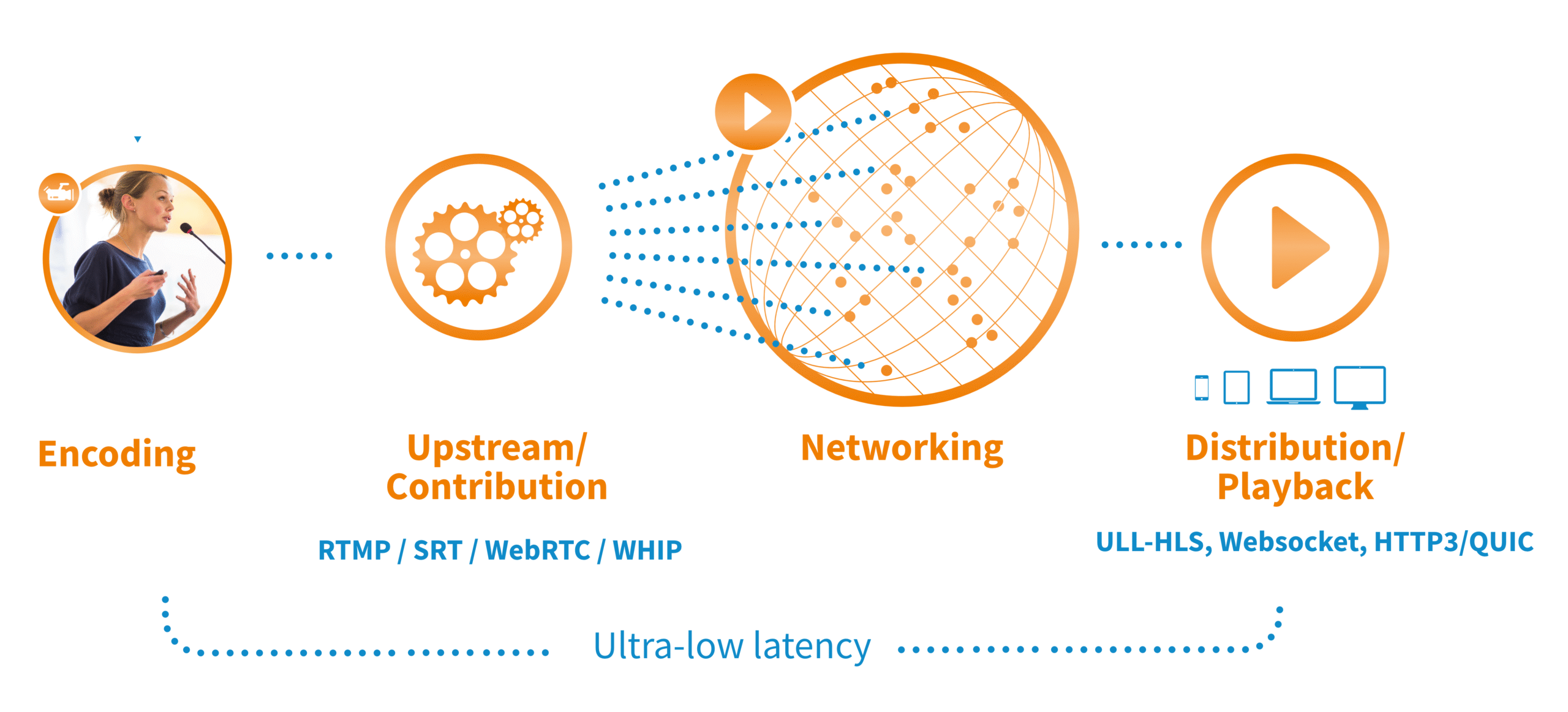
Online video delivery is complex. The glass-to-glass journey includes a ton of steps, including capture, ingest, transcoding, delivery, and playout. The goal is 100% satisfaction and the highest possible playback on any device, in any network. This requires adaptation of the video quality to the local constraints of the internet. You might even change location from a high-bandwidth Wi-Fi to a low-bandwidth, bad mobile network during a session. Automatic adaptation with Adaptive Bitrate is required.
Not only is it time- and resource-intensive to build out an end-to-end streaming workflow, but it also requires a certain level of expertise. That’s why many organizations choose to partner with a company like nanocosmos that specializes in real-time streaming infrastructure.
Here are the spots where latency can build up across a streaming workflow:
- Encoding, transcoding, and packaging: From your on-site encoder to the transcoding service that you use to further process your content, many aspects of the encoding pipeline can inject latency. High bitrates, different codecs, and first-mile upload all contribute to lengthy delays.
- Delivery format and segment size: As mentioned above, standard protocols like HLS and DASH weren’t designed with speed in mind. The actual size of each segment (or chunk) is often a primary driver of lag. What’s more, it’s impossible to get in the sub-second target without an ultra-low latency format like Media Over QUIC (MOQ).
- Delivery to end-users: Geographic boundaries should not limit engaging online experiences. But the farther your viewers are from the edge servers, the longer it’ll take for the video to play. You’ll want to look for a CDN that addresses your specific needs for lightning-fast delivery.
- Playback: Many specifications require a minimum amount of video (number of video segments) to be loaded before a stream will play. This results in a buffer between when a user clicks play and when the live content actually appears. Finding a player with fast startup time and real-time latency will address this final hang-up — giving your audience the instant gratification they demand.
How to reduce Latency?
Latency can creep in at every stage of the workflow, so tackling it requires a comprehensive approach. Optimizing all the stages requires expertise and takes attention away from your main business goals.
On the other hand, solutions like nanoStream handle the technology for you and connect your team with 25+ years of audio and video streaming expertise.
Here’s a closer look at where video delays build up. As you’ll see, the easiest way to ensure high-quality real-time delivery is by controlling the entire streaming pipeline with an end-to-end platform.
1. Efficient Encoding
Whether you’re using a webcam with an open-source encoder like OBS Studio, a tool like ffmpeg, a professional camera connected to a hardware encoder with HDMI or SDI like Osprey Talon, or a browser-based solution, keeping latency low starts here. You’ll want to select an encoder that offers support for the low-latency contribution formats listed below.
At nanocosmos, we have our nanoStream Ready program, where we test and certify encoders to ensure they work seamlessly with our platform for real-time streaming.
2. Low Latency Protocols
Creating top-notch streaming experiences goes beyond the protocols you select. There are many protocols available on different platforms and networks, so it may be confusing to decide which to use. Selecting a real-time video streaming platform that looks at it holistically will make the right choice for you, so you can trust the expertise of a company that knows video inside out.
Low-latency streaming protocols in use:
- SRT: SRT is often used to transport live content to a streaming platform. From there, the video is repackaged into a format that’s suitable for playback, as SRT is not used for client playback, as it is not available in web browsers. SRT ensures quick delivery over suboptimal networks, making it an ideal format for use cases like live auctions, news, and more.
- WebRTC: Ultra-low-latency protocol for ingest and delivery. It was designed for chat-based collaboration and supports browser-based encoding. This makes it great for town hall meetings and scenarios where you’d want to go live from your laptop. That said, scaling video delivery to thousands of viewers requires additional infrastructure. Also, the WebRTC API in browsers is very monolithic with low flexibility on video parameters and options. Every browser implementation behaves differently, which may result in unexpected effects, impacting video quality and user experience.
- Low-Latency HLS: Apple’s spec extension to HLS seeks to overcome the lengthy delay that’s always plagued HLS. The protocol sits at 2-5 seconds, which means it’s still on the higher end for what some use cases require. The setup is complex, and it is more of a workaround for using HLS than a proper, reliable protocol.
- Media Over QUIC: MOQ is a next-generation transport protocol built for media transport, useful for real-time streaming. Based on UDP and QUIC, it improves resilience and stability, even in bad networks. It delivers ultra-low latency, seamless playback, and stream prioritization to ensure bandwidth where it’s needed. MOQ provides a flexible, reliable solution for high-quality streaming. nanocosmos was the first vendor to bring MOQ into global production, instant test here.
- H5Live: Developed by nanocosmos, H5Live has been the go-to technology for ultra-low latency for over 10 years. Based on WebSockets, Ultra-Low-Latency HLS, and fragmented MP4, H5Live ensures sub-second streaming at scale as a key part of the global nanoStream platform. Rather than being a proprietary technology, it intelligently matches the end-user’s device with one of these formats and can be easily embedded in any browser. H5Live also serves as a reliable fallback for browsers where MOQ is not yet supported.

3. Ultra-Low-Latency Content Delivery Network (CDN)
The content delivery network (CDN) is the core of a live streaming platform. It is the workhorse of online video — ensuring that content reaches every corner of the world without buffering or interruptions (regardless of audience size). But guaranteeing a smooth viewing experience for interactive video workflows takes more than a traditional CDN.
When you use a platform like nanoStream, which combines all delivery components, such as an ultra-low latency CDN with a powerful video infrastructure, quick video distribution is the name of the game. With 1000s of PoPs globally, their streaming infrastructure ensures sub-second streaming at a global scale with total reliability. nanocosmos designed it to reach any audience without downtime using dynamic auto-scaling and automatic failover.

4. Live Metadata Support
Keeping the conversation going in interactive video environments requires maintaining a continuous feedback loop with your audience. Interactive overlays like chat functionality, polling, and betting are only possible with timed metadata.
You’ll want to look for a video platform that offers live metadata support. This ensures the interactive elements your users demand can be embedded into live content.
5. Adaptive HTML5 Player
All of the considerations detailed above will amount to very little without an ultra-low-latency player like nanoStream H5Live Player, a key part of nanoStream real-time video platform. Adaptive bitrate delivery, fast video startup time, device compatibility and support for low-latency protocols are all key features to look for (that our player delivers).
6. End-to-End Video Platform
Getting ultra-low latency video right is hard. All of the components detailed above need to work together efficiently. And unless you’re building the next Netflix from the ground up, this is only possible with a complete solution that supports large-scale delivery across the globe.
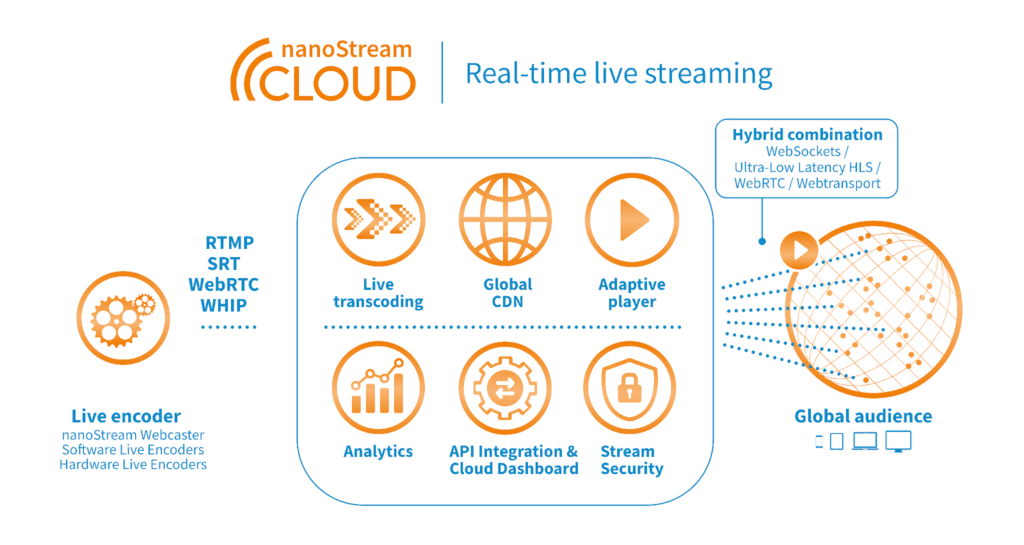
You can only ensure high quality of experiences with ultra-low latency with an end-to-end platform built for just that. Integrating analytics, CDN, and player functionalities into a unified solution ensures the consistent and reliable delivery of your streams across all platforms, with full control and insights. With this approach, operators can focus on monitoring metrics and implementing necessary adjustments to ensure consistently excellent user experiences. This means you can focus on your business while still maintaining full control over the video experience.
Other Considerations When Building Interactive Video Experiences
Keeping your audience captivated goes beyond quick delivery times. It’s about crafting a top-notch experience and service that is high-quality, scalable and user-friendly. This way, businesses can focus on what they do best. There are also other important features to consider when developing an interactive video application to fulfil this goal, as outlined below.
- Analytics: Who cares if your content reaches viewers quickly if their experience is terrible? Insight into the user experience is critical, which is why you’ll want an analytics solution that provides insight into the complete stream performance.
- Security: Securing content is often vital for monetization. Beyond just protecting your streams, it also protects your users and your reputation. Finding a platform with robust security measures also improves reliability, so this isn’t a place to skimp.
- Ease of integration: Unless you’re building all your infrastructure in-house, you’ll want to select a platform that plays nicely with others. Finding a video API that can be integrated with your favourite tools and existing workflows will keep your life simple.
How to start with nanoStream
We designed nanoStream to power the engaging video experiences that demand real-time delivery. Our solution combines all the requirements detailed in this article into a comprehensive solution, so you are in complete control over your video experience.
If you’re ready to build unparalleled experiences that drive business results, there’s no time to waste.
Discover how Media Over QUIC (MoQ) is transforming real-time streaming with ultra-low latency and seamless global delivery—explore the benefits, use cases.