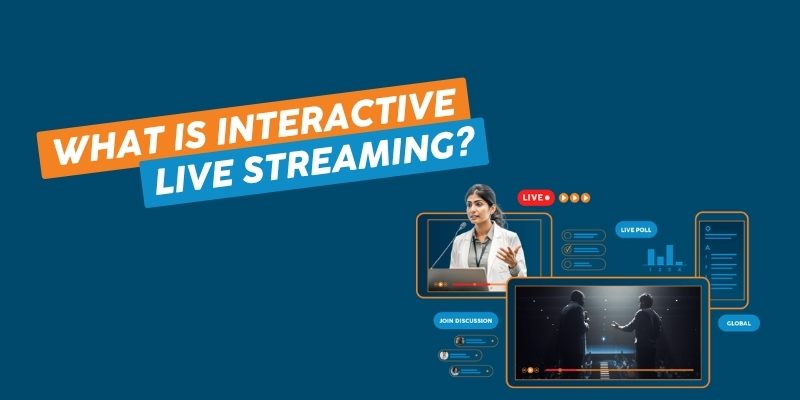
The way we use video is evolving. Both at home and in business environments, we now have the flexibility to access content from any device, with an increasing reliance on mobile devices and networks.
In some cases, end users are still happy to ‘lean back’ and passively watch one-way broadcasts. But more often than not, viewers choose to actively participate in the live feeds they’re tuning into, sometimes influencing the content in real time.
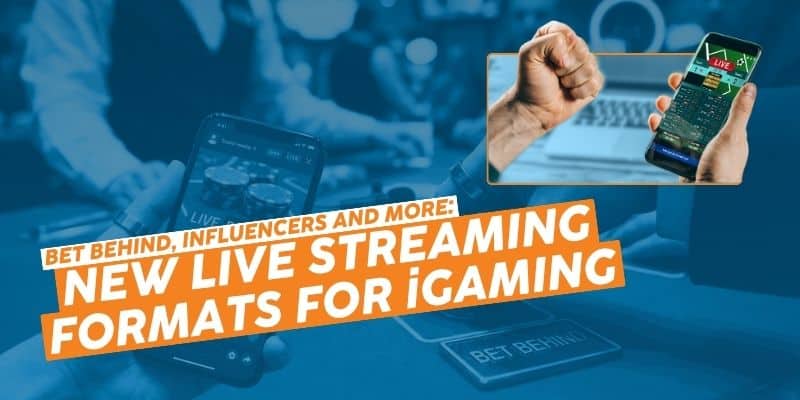
Examples show up everywhere: sports betting platforms that use live wagering to drive revenue, corporate events that use polling and chat to turn a broadcast into a discussion, and newer iGaming formats like bet behind and influencer-led betting streams, where viewers place bets alongside a host in real time.
Quick answer: Interactive live streaming combines real-time video with two-way data exchange (chat, polling, betting) so viewers can influence what they’re watching instead of just watching it. It only works if latency stays under a second. Any slower, and the interaction lags behind the video, breaking the illusion of being there. The nanocosmos platform is built specifically to hold that threshold at scale, which is why it’s used across live casino, corporate events, and interactive betting formats.
There’s no doubt about it: Interactive live streaming has become widespread across countless industries and work environments. So what are the benefits of interactive live streaming and how can companies implement these capabilities? Keep reading for all the details.
Table of contents
What Is Interactive Live Streaming?
Interactive live streaming combines real-time video delivery with two-way data exchange to enable audience participation. This transforms the end-user experience, allowing viewers to engage with live content.
Imagine a live auction where you can bid while streaming the event from halfway around the world, or a virtual town hall where your participation in a poll directly impacts the discussion. These are just a few examples of how interactive streaming fosters viewer participation.
Low-latency video delivery is the backbone of interactive streaming. Without it, real-time interactivity simply wouldn’t be possible. Speedy video distribution permits in-the-moment responses, which makes in-the-moment responses feel instant instead of delayed.
The other core requirement is interactive tools for audience participation. These can include chats, polls, two-way video streams, and more.
Oliver Lietz, CEO of nanocosmos, explains:
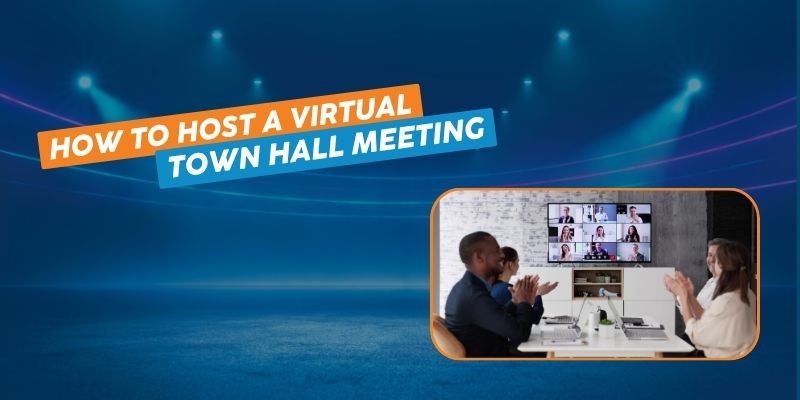
“Interactivity and audience engagement is the key. I see two major use cases for that. One is the enterprise, corporate space where you have town hall meetings to engage the audience by asking questions and allowing them to give feedback through voting, polling, etc.
The other is more like a monetized revenue channel, which is based on things like betting, auctions, and gaming elements. These directly require ultra low latency to keep in the real-time space.
So those specific verticals are not so much connected to OTT TV, but usually have specific business requirements that aren’t just focused on the video itself but the complete use case and workflow.”
Interactive Streaming Benefits
While interactive streaming is nothing new, the pandemic in 2020 accelerated its adoption. Everything went virtual overnight, and viewers demanded the same dynamic experiences that previously occurred in person.
This initial push led to innovation across the industry. As a result, even after social distancing mandates loosened, interactive streaming applications stayed embedded in our lives.
The reason for this is simple: Interactive live streaming doesn’t just provide the utility of conducting in-person experiences from remote locations; it also lays the foundation for more immersive online engagement, which isn’t a short-lived fad.
Here’s a look at the benefits that contribute to this staying power.
Community Engagement
End-user expectations have changed. Rather than just receiving information from a one-way broadcast, people want to feel a sense of community. Interactive streaming does just this by transforming viewers into co-creators. This fosters a collaborative environment where viewers can influence the content, share their perspectives, and virtually connect.
Global Accessibility
It used to be that if a one-time auction was scheduled to take place and you couldn’t make it to the physical location, there wasn’t much to be done. But with interactive live streaming, people from every corner of the world can attend these events and take part in the action. Interactive streaming has also transformed modern enterprises by making it possible to work and collaborate from anywhere.
Increased Revenue
Building on the live auction use case, interactive streaming ensures that each item sells at its proper valuation by opening up the bidding pool to those unable to physically attend. More participants mean more monetization opportunities for most online experiences — making interactive streaming a no-brainer.
Enhanced Learning
Interactive features like live Q&A sessions and polls help transform boring presentations into dynamic learning experiences. This invites viewers to actively participate, get clarification, and retain information more effectively than they would through passive viewing.
Improved Brand Loyalty
By fostering a two-way dialogue and addressing audience needs directly, interactive streaming strengthens brand-audience relationships. Viewers feel valued and engaged, leading to increased brand loyalty and advocacy.
Extended Viewing Times
Interactive elements like gamification features, live challenges, and virtual rewards can significantly boost the entertainment value of a live stream. This keeps viewers engaged for longer durations and creates a more memorable experience.
Examples of Interactive Streaming
At nanocosmos, we partner with organizations across industries to deliver the cutting-edge streaming technology that today’s virtual environments require. Our platform delivers on the low latency, reliability, and scalability required to support interactive streaming experiences.
Here’s a look at some of the organizations we’ve partnered with to drive innovation.
Sports Betting With Highlight Games
In today’s online gambling environments, players make split-second decisions while watching live events. Online casinos, sportsbooks, and other igaming platforms need ultra-low-latency streaming to ensure their participants’ bets are placed on time. And with new use cases like microbetting gaining momentum, the requirement for speedy video delivery continues to grow.

Highlight Games – Microbetting Soccer
Highlight Games creates unique betting and gaming opportunities that capitalize on this trend. The UK-based provider has revolutionized the industry by rolling out new products across the globe, including “video virtuals” (4-5 minute games that involve betting on pre-match markets) and “instant wins” (shorter on-demand games that only involve selecting your stake and pressing start before the highlight show).
Corporate Events With Twebcast
Anyone who’s participated in a Zoom meeting knows that video delays can be awkward and frustrating. As more events go virtual, enterprises are looking to power real-time collaboration across distances. Replicating the in-person experience requires combining real-time delivery with employee interactivity.
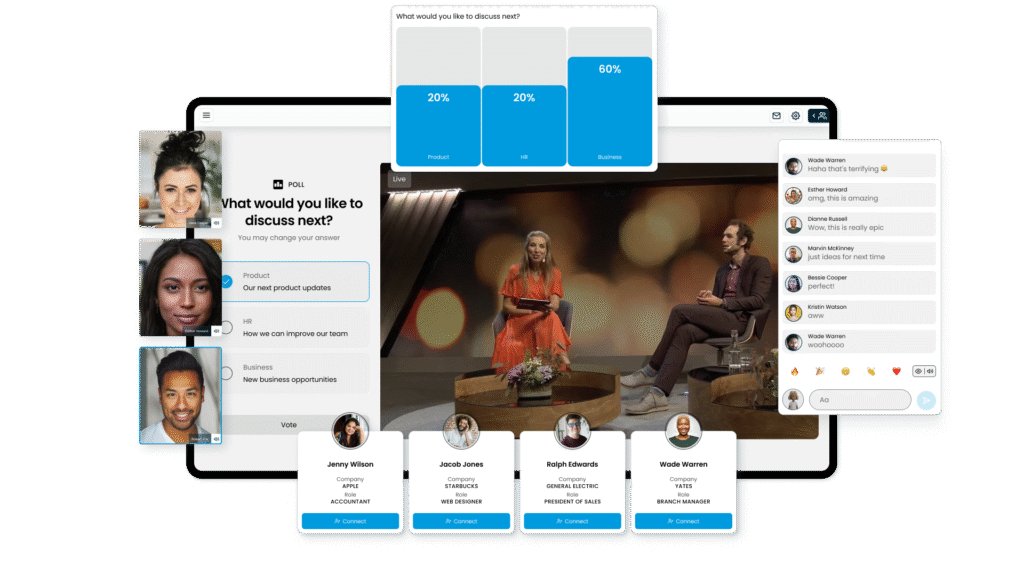
Twebcast is a premium live event platform for global enterprises running hybrid and digital events. The platform integrates Interactive elements like chat, polls, Q&A, live reactions, and gamification with real-time streaming from nanocosmos to engage viewers and allow instant feedback. By supporting global stream delivery in under one second, the platform enables attendees to interact with presentations and influence the content.
Live Auctions With Wegner Live
When it comes to auctions, timing is everything. Buyers are motivated by the urgency that real-time streaming delivers. What’s more, the ability to place a bid in a timely fashion requires sub-second latency.
Wegner Live, a leading Swiss broadcaster, delivers engaging and seamless auction experiences using the nanocosmos platform. Viewers can access the live streams directly from their web browsers and place bids without any delays. Roland Wegner, CEO of Wegner Live, highlights the value of using the platform as the company’s real-time streaming infrastructure.
“We let some auction streams run 10 hours nonstop, like recently at one of Europe’s most important auction houses, Galerie Kornfeld in Bern.
Perfect sound and perfect picture, despite ultra-low latency, are advantages of nanoStream that we do not want to miss. The fact that the stream is adaptive favors increasing sales figures: With browser-based public broadcasting, the audience can grow quickly, but must not interfere with the stream in progress”
Technical Requirements of Interactive Streaming Services
Building interactive streaming services like the ones detailed above is no walk in the park. A few competing priorities need to work together at once.
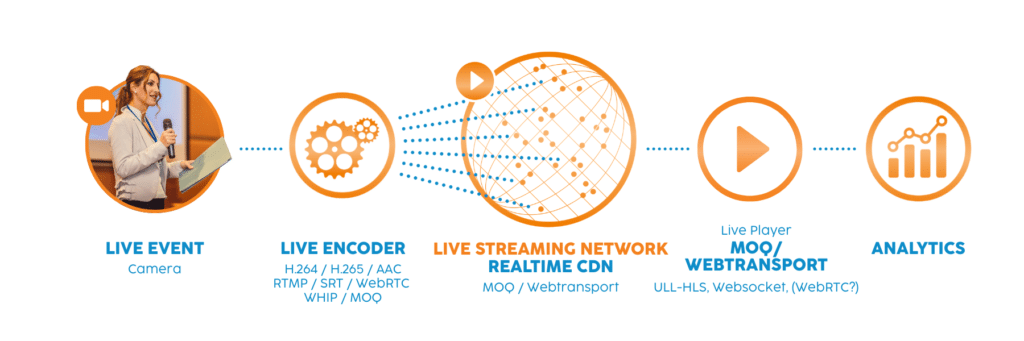
- Real-Time Video Delivery: While some lag is acceptable for one-way live broadcasts, interactive streams demand sub-second delays. Different technologies can support low-latency streaming, but every component needs to work together for real-time delivery actually to hold up. For this, you’ll want an end-to-end platform like the nanocosmos platform, built on MOQ (Media over QUIC).
- Two-Way Audience Engagement: Interactive streaming needs a continuous feedback loop between the content and the end users. Third-party tools for chat, polls, and the like only work when the video platform underneath offers live metadata support and solid APIs.
- Scalability and Reliability: As a rule of thumb, the more interactive a video experience is, the harder it is to scale. The larger the audience, the more resources it takes to keep things running smoothly. If your goal is a large audience with a smooth two-way experience, you need a cloud-based solution built for both low latency and scale.
Here are the technical features that check those three boxes.
Live Transcoding
Transcoding takes a stream, reprocesses it, and re-encodes it for delivery to end users. It’s how you get smooth playback across every device, using technologies like adaptive bitrate streaming.
When building interactive video experiences, your streaming infrastructure can’t add delay during this process. Look for a solution built on MOQ (Media over QUIC), the current standard for real-time delivery, with WebRTC and H5Live available as fallback protocols.
Ultra Low-Latency Global CDN
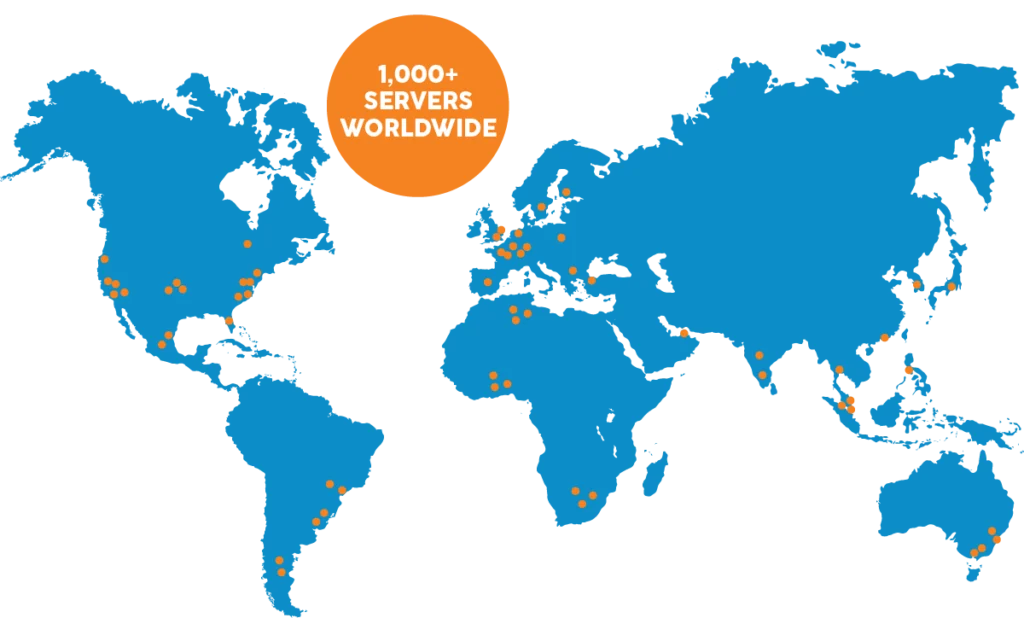
Content delivery networks (CDNs) get content to every corner of the world without buffering or interruptions. If interactivity matters for your use case, go with an ultra-low-latency CDN like nanoStream, powered by MOQ, that supports sub-second streaming at scale.
Live Metadata Support
Interactive overlays like chat, polling, and betting only work with timed metadata. Look for a video platform that supports live metadata and offers solid APIs, so the interactive elements your users expect can be embedded directly into live content.
Dynamic Real-Time Player
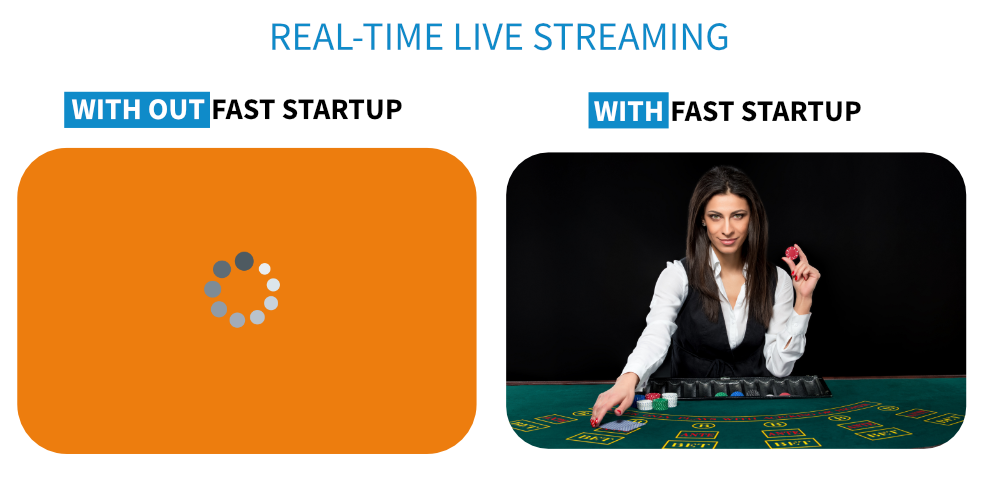
Adaptive bitrate delivery, fast startup time, and support for low-latency protocols all matter for a smooth viewer experience. A player built for this keeps the dreaded buffer wheel off your audience’s screen and gives them the instant streaming experience they expect.
Analytics
Low latency and a fast startup are great in theory. But if the viewer experience is choppy anyway, none of that matters. This is why analytics into stream performance matters just as much. Visibility across the whole workflow helps you make real decisions instead of guessing, and keeps the focus on your viewers.
End-to-End Video Platform
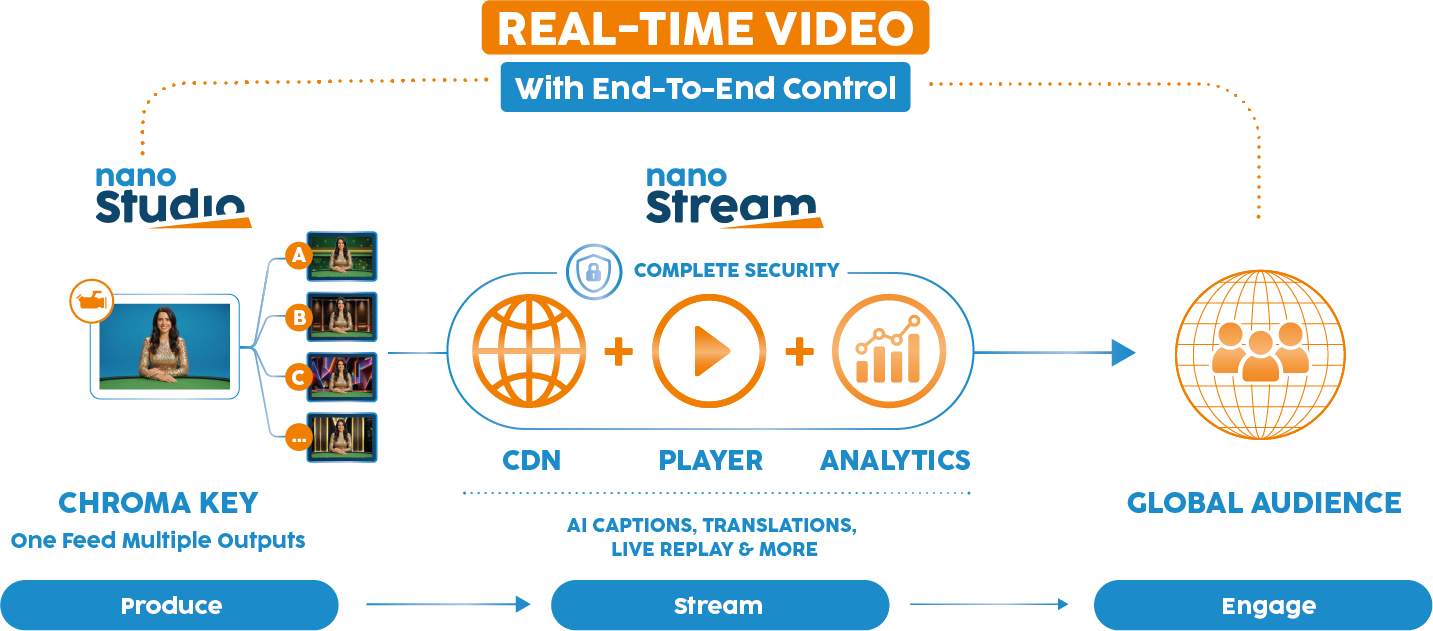
Some businesses take a piecemeal approach, stitching together a video server, an HTML5 player, and a separate analytics tool. That approach adds complexity, breaks visibility across the workflow, and fragments support when something goes wrong.
With an end-to-end platform like nanocosmos, businesses move faster and keep the workflow in one place.
How to Get Started With the nanocosmos platform
The nanocosmos platform is built around two cores: nanoStream handles delivery, security, and audience experience, while nanoStudio covers cloud-based production, including capabilities like Cloud-Based Chroma Key. For interactive streaming specifically, nanoStream is the core that matters most, since it’s what carries the real-time video and the two-way data exchange your use case depends on.
We built nanoStream to power exactly the kind of interactive, real-time experiences covered in this article, running on MOQ (Media over QUIC) for consistently ultra-low latency at scale.
Ready to build this into your platform? Start for Free.
Learn more
MOQ (Media over QUIC) is the protocol behind nanoStream’s real-time delivery. See how it compares to older streaming protocols and why it matters for interactive use cases.