When it comes to video communication and conferencing applications for interactive live streaming applications, you need a real-time video technology to run your application.
Which technologies are available for low-latency live streaming? There are only a few, especially for browser-based streaming. HLS, with some low-latency extensions, WebRTC, focused primarily on real-time communication, and newer protocols like MOQ (Media-over-QUIC), potentially covering more use cases than other protocols.
Web Real-Time Communications (WebRTC) has proven to be a reliable technology for fast video delivery. The lightning-fast format powers countless browser-based applications like the open-source video meeting tools Jitsi Meet, Big Blue Button, and commercial applications like Slack and Amazon Chime.
With its inception, WebRTC was able to reduce the stream latency compared to other formats like HLS and was the only format available in the browser for real-time communication, which is important for audience engagement with real-time interaction.
So, what’s the secret sauce behind WebRTC’s ultra-low-latency capabilities, and how does it compare to other streaming protocols? Which challenges are there, and which solutions? We cover it all in this article.
Table of content
What Is WebRTC?
WebRTC delivers near-instantaneous audio and video streams to and from any major browser. As a plugin-free technology, it also eliminates the need for third-party player software and encoding hardware.
The framework’s combination of standards, protocols, and JavaScript APIs makes it a popular option for developers looking to replicate in-person interactions online. All you need is your browser to capture, encode, and transmitlive video streams when using WebRTC. As a result, broadcasting immersive experiences can be as easy as just a few clicks (and some coding know-how).
For this reason, many developers have built click-to-start video environments using WebRTC. But that’s not to say that the open framework is without limitations. Creating an application layer around it is complex. And because WebRTC was designed for chat-based collaboration between a handful of participants, challenges can arise when adapting it to different real-time video use cases with larger audiences.
What Is WebRTC Latency?
WebRTC latency — or the delay between the video capture and playing back on a viewer’s device — typically clocks in at sub-500 milliseconds (or .5 seconds). This makes it one of the speediest streaming technologies out there and a popular choice for building interactive online environments.
However, this latency is not guaranteed in all situations, and it’s only possible in workflows that use WebRTC from end-to-end (often without an intermediary streaming server or service). For instance, many live chatting apps leverage WebRTC to power real-time collaboration.
When using WebRTC for large-scale broadcasting, it’s necessary to bring additional infrastructure and streaming formats into the mix that support large-scale distribution. In these cases, the latency can range anywhere from 0.5 to 60 seconds.
Why would such an expansive range result from adapting WebRTC to broadcast-based workflows? To explain, we’ll need to take a look at other streaming protocols out there and WebRTC’s limitations.
WebRTC Challenges and How to Solve Them
- Scalability: As a peer-to-peer technology, WebRTC wasn’t designed for large-scale broadcasting. You’ll need additional protocols when live streaming to transcode it into an alternative protocol when streaming to more than 50 concurrent connections.
- Quality: The viewer with the worst network condition determines the quality. This happens because WebRTC achieves ultra-low latency by adjusting the stream quality to the network conditions of the sender and receiver. This makes quality suffer in one-to-many delivery. By ingesting WebRTC streams and then transcoding into ABR, broadcasters can decouple the ingest quality from network conditions on the viewer side and control latency via adaptive delivery.
- Flexibility: The WebRTC API is monolithic and unflexible in codec configurations. A simple example: no web browser enables B-Frames for video coding, and bitrate configurations are limited, and things like adaptive bitrate, balancing latency/buffering cannot be configured flexibly. WebRTC just drops frames in case of bottlenecks.
How Does WebRTC Latency Compare to Other Streaming Protocols?
Looking at traditional broadcasting environments, traditional protocols like HLS and DASH have long been the go-to choice. They were designed for one-to-many broadcast delivery with high latency, which works well for video-on-demand or linear streaming, but not for interactive use cases where every millisecond counts.
When talking about speed, WebRTC commonly comes to mind. It was developed specifically for real-time, peer-to-peer communication. While it can deliver sub-second latency, its peer-to-peer design makes WebRTC suited for small, direct communication rather than large-scale, one-to-many applications involving diverse and unpredictable internet connections.
As a result, WebRTC is not a practical choice for new interactive applications such as town halls, iGaming, or live auctions, where it leads to highly complex architectures, scalability challenges, and ultimately lower and less consistent media quality.
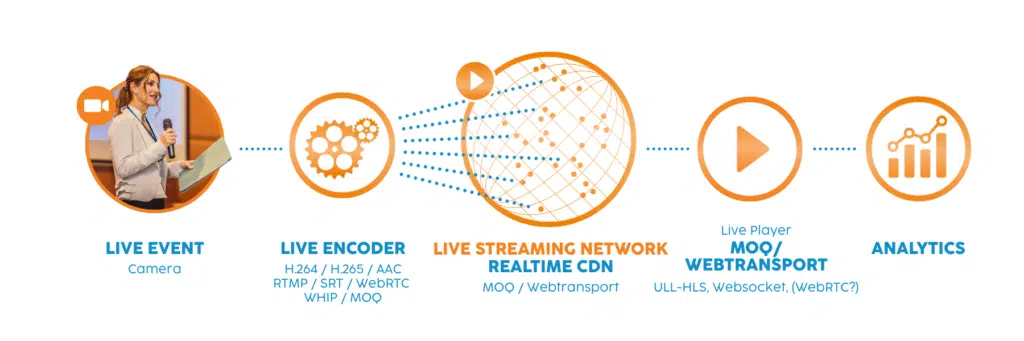
New technology for real-time streaming: Media over QUIC (MOQ)
New technologies like Media over QUIC (MOQ) and proprietary implementations like H5Live extend this capability by combining low-latency performance with greater scalability and delivery flexibility. This significantly expands the use cases for ultra-low latency live streaming.
MOQ builds on the QUIC transport protocol to improve performance on unreliable networks and to support broader content delivery without sacrificing responsiveness, while keeping consistent sub-second latency. A comprehensive approach gets the best of all worlds.
On the downside, MOQ is still not supported in all browsers. That’s when protocols like H5Live are a great option. Developed by nanocosmos and being used globally for over 10 years, it is a smart technology that selects the right protocol for each user, maintaining ultra-low latency and available in all browsers. It works as a great fallback solution for MOQ.
Together, MOQ and H5Live represent a shift in how we build live streaming infrastructures, moving away from high-latency broadcast formats toward interactive, responsive, and globally scalable real-time video architectures that support modern enterprise, sports, gaming, and corporate use cases.
Do I always need low-latency protocols? No! Think about valuable use cases for monetizing low-latency live streaming: audience engagement, Q&A, voting, polling, live auctions, betting, shopping, gaming, and gambling.
WebRTC vs. MOQ vs. HLS vs. RTMP and More
| HLS and MPEG-DASH | RTMP and RTSP | WebRTC | H5Live (with or without MOQ) | MOQ | |
| Latency | 6-60 seconds, with 6 seconds only possible when tuned for reduced latency. | 5 seconds or less. | Sub 500 milliseconds (can also go higher based on the configuration). | Sub-second end to end. | Sub-second end-to-end. |
| Delivery Method | TCP | TCP | UDP | TCP / UDP (hybrid combination- WebSockets, Ultra-Low-Latency HLS, WebRTC, Webtransport) | QUIC, Webtransport |
| Compatibility | Ubiquitously supported across end-user devices and browsers (but iOS and Apple TV only support HLS and do not natively support DASH). | No longer accepted by browsers, embeddable players, or devices. Still valid and useful for ingest. | Chrome, Firefox, and Safari support WebRTC without any plugins. | Ubiquitously supported across end-user devices and browsers. | Supported across end-user devices and browsers (except Safari on iOS – will be available later in 2026). |
| Scalability | As cacheable segment-based HTTP protocols, HLS and DASH can easily be scaled across a CDN. Scale up to millions | Not supported by CDNs for delivery, but still widely used for ingest. | As a peer-to-peer technology, WebRTC wasn’t designed to scale to more than 50 concurrent connections. | nanoStream CDN is an integral part of the solution, which also supports adaptive bitrate delivery (ABR). Scale up to hundreds of thousands (100000+) | nanoStream CDN is an integral part of the solution, which also supports adaptive bitrate delivery (ABR). Scale up to hundreds of thousands (100000+) |
| Use Case | One-way broadcasts where latency doesn’t matter. | RTMP is the industry standard Ingest protocol, while RTSP supported IP camera surveillance systems and video contribution. | nanoStream CDN is an integral part of the solution, which also supports adaptive bitrate delivery (ABR). | Large-scale interactive environments like igaming, townhalls, live auctions, virtual marketplaces, sports betting, and more. | Large-scale interactive environments like igaming, townhalls, live auctions, virtual marketplaces, sports betting, and more. |
Breaking down protocols:
- HLS and MPEG-DASH: These HTTP-based protocols support reliable streaming to any device and can be distributed across web servers for limitless scalability. While it’s possible to tune the protocols for as low as six seconds of latency, this introduces complexity and compromises reliability. You’re best off using HLS and DASH when latency serves no benefit, such as one-way streams and linear programming.
- RTMP and RTSP: As long-standing technologies in the video streaming space, RTMP and RTSP often play a role in video contribution. Also called ingest, this describes the process of transporting a live stream from the camera or source device to a streaming platform like the nanoStream.Most content distributors then repackage RTMP streams into a different protocol to play back on end-user devices. This extra step can introduce latency, but it isn’t something you’d want to skip. No browsers and most user devices today don’t natively support RTMP playback.
- H5Live: One of the only technologies out there that can compete with WebRTC in terms of delivery speed is our very own H5Live technology. It’s also supported by all HTML5 browsers. Based on WebSockets, Low-Latency HLS, and fragmented MP4, H5Live ensures sub-second streaming at scale. Rather than being a proprietary technology, it intelligently matches the end-user’s device with one of these formats and can be easily embedded in any browser.
- Media over QUIC (MOQ): Media over QUIC is a next-generation real-time streaming protocol designed for ultra-low latency and global scalability. Built on the QUIC and Webtransport transport layer, it improves performance on unreliable and mobile networks by reducing connection delays and handling packet loss more efficiently. MOQ bridges real-time communication and large-scale content delivery, making it well-suited for interactive live streaming and enterprise use cases.
WebRTC vs. MOQ
WebRTC can deliver sub-500 ms latency and works well for point-to-point or small group interactions directly between peers. However, WebRTC was not originally designed for large-scale delivery or broadcast-style streaming; as a result, extending it to support global audiences often requires additional infrastructure such as SFUs, STUN/TURN servers, and complex integration layers, which can add operational complexity and limit flexibility at scale.
MOQ, on the other hand, covers several use cases with a flexible API. Including one-to-many applications. The complexity overhead is much lower than in WebRTC, with a much better flexibility in stream configuration.
In 2025, nanocosmos was the first global live streaming provider who added MOQ (Media over QUIC) to the nanoStream platform as a next-generation transport protocol for real-time media delivery. Built on QUIC and Webtransport, MOQ enables even lower latency and improved network stability compared to other workflows. It provides better adaptability to fluctuating network conditions and scales naturally for interactive real-time video use cases like live events, iGaming, and corporate streaming — all while simplifying deployment and maintaining high performance.
You can try MOQ for free to experience its benefits firsthand.
WebRTC vs. H5Live
There are different protocols available on both ingest and playout workflows. More and more applications use MOQ as it is very flexible and works on both ends (Early access OBS plugins are available for MOQ in 2026). WebRTC may still be useful on the browser-based ingest side until MOQ is a useful replacement.
H5Live covers all the good options available for interactive and ultra-low latency streaming. But, as mentioned before, because WebRTC and MOQ are only technology components and not a complete solution, they need more applications around them to really work in production environments. Without a powerful CDN, you may run into issues when streaming to large audiences on any network or device across the globe. nanoStream H5Live, backed by their CDN, helps address these shortcomings by employing highly-available HTML5 technologies.
Having said all this, it’s not only about finding the right streaming protocol. There are many challenges when delivering video, and the streaming technology is only one of them. You need a complete CDN and full control over all components and data insights to maintain quality. Thinking about your workflow holistically is important to creating a proven application with a great user experience
Using the nanoStream platform, you don’t have to choose just protocols. The comprehensive platform provides a fully scalable system with the flexibility of easy integration into custom applications.
Low-Latency Streaming Use Cases for WebRTC, MOQ and H5Live
Who should be prioritizing low-latency streaming technologies like WebRTC, MOQ and H5Live? It all has to do with the real-time video use case.
As a general rule of thumb, the more passive a broadcast is, the more delay it can handle. But when you get into distributing interactive content, like in the examples below, timely video delivery is key to the viewing experience.
- Online betting and igaming: Today’s online betting environments lure in participants because of their fast pace. Everything from horse tracks and basketball games to casinos and bingo halls has moved online to reach gamblers. Real-time streaming underpins these dynamic environments by providing a seamless experience for participants.
- Live auctions: With online auctions and online marketplaces, any video delay could mean the difference between an item going unsold and a full-on bidding war. Fractions of seconds cost thousands when money is on the line. To successfully bring your auctions online, you’ll need to combine real-time interactivity, scalability, and mobile-friendly playback. And for that, you’ll need nanocosmos.
- Corporate Events: As organizations increasingly operate across regions and time zones, live streaming has become a core communication channel. Town halls, product launches, investor briefings, and training sessions now rely on interactive video to connect leadership with distributed audiences in real time. Low-latency technologies like H5Live, and MOQ enable live Q&A, instant feedback, and real-time participation that help recreate the dynamics of in-person events in a digital environment.
- Mission-critical operations: In environments such as public safety, remote inspections, healthcare support, and industrial operations, real-time video is often tied directly to decision-making. Delays of even a few seconds can affect outcomes, safety, and efficiency. Low-latency and highly reliable streaming technologies allow responders, operators, and experts to see situations as they unfold, coordinate actions, and make informed decisions in the moment.
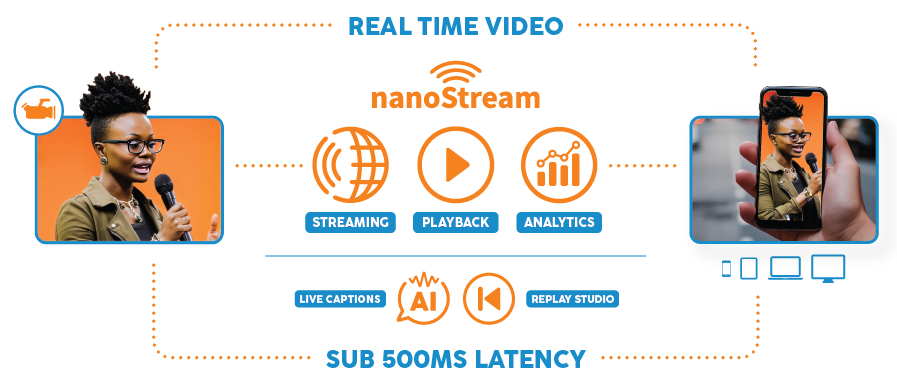
How to Stream Low-Latency WebRTC at Scale With Nanocosmos
The nanoStream platform combines the low-latency, plugin-free benefits of WebRTC with global streaming to large audiences.
nanocosmos has integrated WebRTC at the ingest and contribution layer of the interactive live streaming workflow. nanoStream supports WebRTC ingest from any modern web browser on desktop or mobile, as well as through WHIP-compatible clients such as OBS.
The potential of MOQ is so high that we consider it also a valid replacement for WebRTC, even for browser-based ingest in the future. As of early 2026, we have proven to make an end-to-end solution work with MOQ ingest from OBS, and downstream delivery with MOQ to a global live streaming audience at the MonteVIDEO Summer Project.
By using nanoStream Webcaster with nanoStream, you’re able to go live directly from your web browser. From there, your streams can be distributed via H5Live or MOQ for sub-second streaming delivery to massive audiences worldwide.
In addition, the nanoStream Ready Partner Program extends this ecosystem by working with certified technology partners. It includes validated hardware encoder providers to ensure reliable, production-ready contribution workflows. All integrate seamlessly into the end-to-end real-time video platform.
nanoStream can also be integrated with video meeting applications like Zoom or Jitsi Meet. You can use these platforms as a meeting frontend and stream out to a global live streaming audience.
Architecting interactive live streaming deployments with ultra-low-latency is about more than just selecting the right protocols. Your configuration, network, server infrastructure, CDN, player, encoder, data insight, and security all impact the end-user experience. That’s why organizations rely on nanocosmos to provide a comprehensive solution that ensures a great audience experience.
With nanoStream Cloud, you’ll benefit from:
- Global Content Delivery Network (CDN): With 100% uptime and continuous 24/7 operations, our low-latency CDN guarantees high availability with no interruptions. That means your users can engage from every corner of the globe.
- Dynamic Real-Time Player: Our easy-to-embed player combines seamless playback with sub-second latency — delivering on all your viewers’ expectations and more.
- Studio features: nanoStream integrates studio features that extend the lifecycle and impact of every live event without compromising real-time performance. Organizations can add AI-powered live captions and multilingual translation, alongside features such as live replay, instant remix, and built-in recording. This ensures accessibility, inclusivity, and content reuse are part of the same end-to-end platform.
- Advanced Analytics: Harness the power of our analytical tools to derive meaningful insights. By using the nanoStream , you’ll gain observability across the workflow to inform business decisions.
- Security: The nanoStream integrates security and professional support directly into its end-to-end streaming platform. Secure ingest, access control, and stream protection help prevent unauthorized access and misuse. Moreover, 24/7 monitoring and expert support ensure reliable performance, fast issue resolution, and continuous optimization.
- Flexible Integration: Takes your RTMP, SRT, WebRTC, WHIP, MOQ Live Stream supported by our APIs and Dashboards to integrate with global live streaming easily.
So what are you waiting for? Start a free trial today to see low-latency WebRTC in action using nanoStream.